
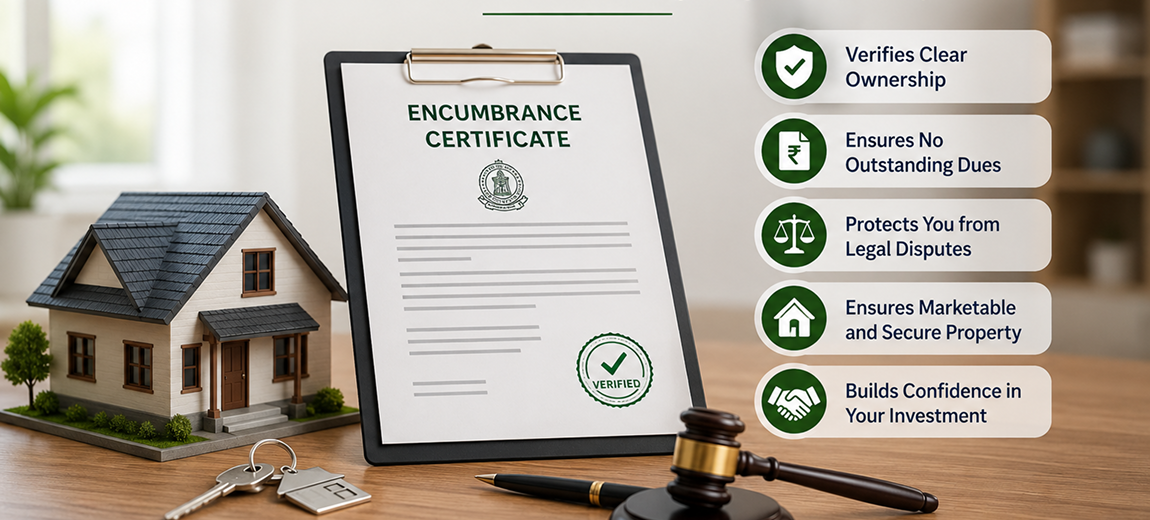
One of the most meaningful life decisions is purchasing an investment property. Discovering the right property is just as important as making sure it is transparent financially and legally. Dream investments might become long-term disadvantages due to hidden liabilities like unpaid debts, ownership disputes or unsettled claims. This is precisely where the Encumbrance Certificate (EC) proves vital.
The Encumbrance Certificate (EC) is a necessary document in the ever-evolving real estate industry, where financial obligations and aspirations intersect. The EC is a non-negotiable criterion that guarantees a property is free from financial or legal obligations, making it more than just a formality to any discriminating buyer or investor.
At ADHYA by Purnaya Developers, we maintain honesty and openness to ensure seamless transactions while building lasting client trust. For instance, it is essential to understand the meaning of an encumbrance certificate before proceeding with the subsequent property ownership procedure.
What is an Encumbrance Certificate?
An Encumbrance Certificate is an official record issued by the Sub-Registrar’s Office, capturing all registered transactions related to a property over a specific time period. It is essentially a legal assurance that the property:
- Is free from loans, mortgages or claims.
- Holds a clear history of ownership transfers.
- Can be transferred, mortgaged or traded lawfully without raising any issues.
By confirming that the property is unencumbered and marketable, the EC essentially safeguards the buyer.
Why the EC Matters: Beyond Just a Document
1. Proof of Legal Ownership
- The EC authenticates the seller’s right to sell the property. It reveals the chain of past ownerships, preventing fraudulent sales and disputes.
2. Revealing Hidden Liabilities
- Properties may carry loans, unpaid dues or unresolved mortgages. The EC exposes these liabilities, ensuring you do not inherit financial risks.
3. Mandatory for Home Loans
- Banks and housing finance companies require a clean EC before sanctioning loans. It is their guarantee of your property’s marketability.
4. Safeguarding Future Value
- Without a valid EC, resale or transfer of the property becomes complex and often depreciates the property’s worth. With it, your investment stays secure.
How is an Encumbrance Certificate Obtained?
The process of securing an EC is streamlined as follows:
Application
- The buyer or owner applies at the Sub-Registrar’s Office (or online, where available), specifying the time span of inquiry.
Verification
- The office reviews all registered deeds, mortgages, releases and transactions tied to the property.
Issuance
Two outcomes are possible:
- Form 15: Shows details of encumbrances (if any).
- Form 16: Confirms no encumbrances exist.
This process guarantees accuracy, giving both buyers and financial institutions confidence in the transaction.
EC vs. Other Property Documents
Although necessary, documentation such as the Sale Deed, Khata or Patta does not confirm whether a property is free of liens and conflicts. An authoritative record of financial obligations and ownership history can be found in the Encumbrance Certificate alone.
This is why experienced investors, legal advisors and banks treat the EC as the ultimate safeguard in property transactions.
Scenarios Where an EC is Indispensable
- Purchasing Land or Plots – Especially when properties pass through generations or family settlements.
- Buying Resale Homes – To ensure no previous mortgages or disputes linger.
- After Loan Repayment – To confirm that banks have removed encumbrances on a property.
- Inheritance Properties – To validate that inherited assets are debt-free before transfer.
Risks of Skipping the EC
Purchasing a property only to find out later that it is bank-mortgaged or involved in unsolved conflicts. Without an EC, these risks materialize and result in monetary loss, legal issues and psychological distress.
An EC is a safeguard against doubt, not only documentation. Ignoring it could turn a potential investment into an expensive error.
Our Promise: Transparency You Can Trust
At ADHYA by Purnaya Developers, integrity is the cornerstone of our projects. Every property is supported by authenticated Encumbrance Certificates and clear paperwork when working with us. With no worries about hidden liabilities, our customers take ownership with complete clarity and peace of mind.
We build trust rather than just create spaces. We provide more than just a place to live; it gives future generations certainty by prioritizing compliance and openness.
Conclusion
In real estate, due diligence is not optional, it is essential. The Encumbrance Certificate stands as the ultimate testimony of a property’s legal and financial health, ensuring that your investment is both safe and future-ready.
At ADHYA by Purnaya Developers, we advocate for informed decisions and responsible ownership. As you take steps toward securing your dream home or investment, remember: a property without an Encumbrance Certificate is a risk too great to take.
Choose Clarity. Choose Security. Choose ADHYA by Purnaya Developers!